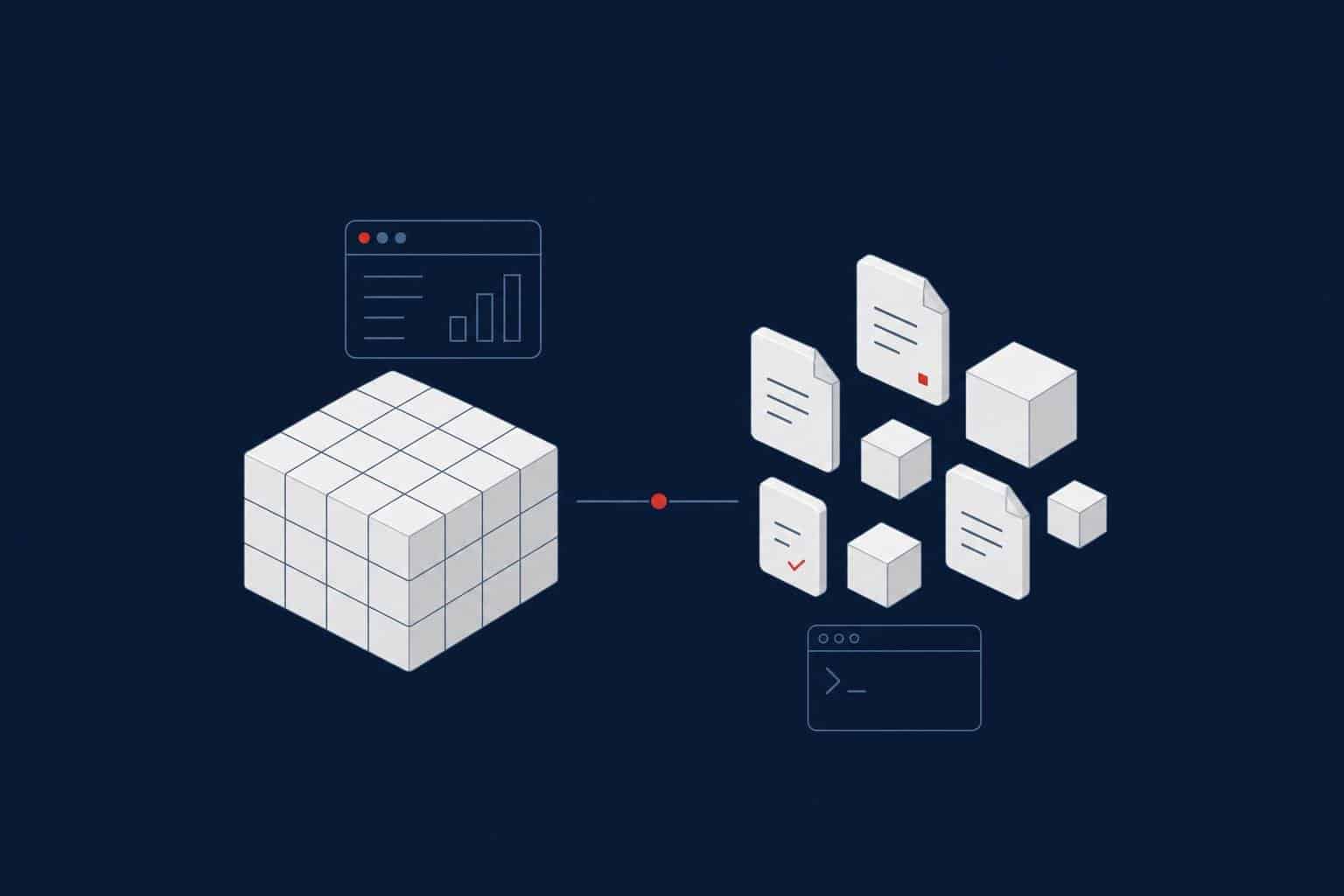
“Relational database or NoSQL?” is usually asked as a false dilemma. The two aren’t rival solutions to the same job; they’re tools designed for different data and access patterns. What’s right for an order and accounting system may not be right for a session cache or sensor data from millions of devices. And today, relational databases such as SQL Server and PostgreSQL also support JSON, graph and vector data natively, so the line isn’t as sharp as it used to be.
This article covers the core differences between the two approaches, the types of NoSQL, and when each makes sense.
Choosing the right database for your project?
With SQL Server, PostgreSQL, Oracle and MySQL experience, Aryasoft recommends the architecture that fits your data and access patterns.
Core Differences
| Feature | Relational (SQL Server, PostgreSQL, Oracle, MySQL) | NoSQL |
|---|---|---|
| Data model | Tables, rows, columns and the relationships between them | Document, key-value, wide-column or graph |
| Schema | Defined up front; validated on write | Flexible; often interpreted on read |
| Consistency | ACID transactions; consistency comes first | Mostly eventual consistency; some products offer transactions too |
| Scaling | Mainly vertical; replicas for reads | Designed for horizontal scaling (sharding) |
| Query language | SQL; strong at joins, aggregation and complex queries | Product-specific APIs or query languages; joins are usually limited |
Types of NoSQL
- Document databases: store data as JSON-like documents. Suited to scenarios where each record’s structure can differ, such as content management, catalogs and user profiles.
- Key-value stores: very fast access to a value by its key. Ideal for session data, caches and counters.
- Wide-column databases: a distributed design for very large, write-heavy, time-series-like data.
- Graph databases: for cases where the relationships between entities are what you query: social networks, recommendation systems, fraud detection.
When Is a Relational Database the Right Choice?
- When consistency and ACID guarantees are a must, for money, stock, orders and invoices.
- When the data has many relationships and reporting needs complex joins and aggregations.
- When the data model is fairly stable and data quality must be protected at database level (with constraints).
- When audit, regulatory and authorization requirements are high.
When Does NoSQL Make Sense?
- When the data structure varies a lot from record to record and changes often.
- When you need very high write volume and geographically distributed horizontal scaling.
- When the access pattern is simple: mostly reading and writing by a single key.
- For cache and session data that needs sub-millisecond latency.
Note
Modern relational databases offer some of NoSQL’s strengths too. SQL Server supports JSON data (with a native json data type in SQL Server 2025), graph tables and vector search. PostgreSQL’s JSONB type is strong for document-like data. Instead of moving the whole system to NoSQL because one area needs flexibility, using JSON columns inside the relational model is often enough.
Polyglot Persistence
Most large systems don’t use a single type of database: transactions live in a relational database, sessions in a key-value cache, search in a search engine and analytics in a data warehouse. This approach uses the right tool for each job, but every new type of database means extra operational load for backups, monitoring, security and expertise.
Tip
Before adding a new database technology, check whether your existing relational database already covers the need. The operational load of an extra technology (backups, high availability, patching, monitoring, team skills) is often bigger than the expected performance gain.
Decision Checklist
- The data’s consistency requirement (ACID or eventual consistency) is defined.
- Access patterns (complex queries or key-based reads) are clear.
- Expected data volume and scaling needs are measured.
- Whether the existing relational database’s JSON, graph or vector features are enough has been assessed.
- The operational load and team skills for a new technology have been considered.
Related Reading
Database Consulting
Choose the right database for the right job
With SQL Server, PostgreSQL, Oracle and MySQL experience, Aryasoft’s senior team analyzes your data and access patterns and recommends an architecture that balances performance, consistency and operational load.